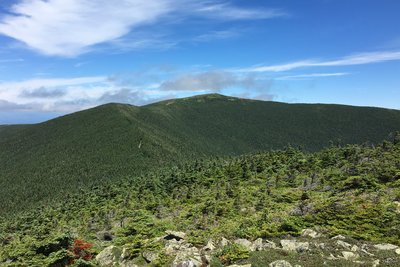
Mount Moosilauke rises to 4,800 feet at the southwestern edge of the White Mountains, its fully treeless summit offering unobstructed views in every direction: the Kinsman Range to the north, the Presidential Range to the northeast, Lake Winnipesaukee to the southeast, and the Green Mountains and Adirondacks to the west. The summit plateau, composed largely of mica schist shaped by the Acadian Orogeny roughly 400 million years ago, has a wind-scoured, open character unlike the forested ridges to the east. Dartmouth College has owned much of the mountain since 1920, and the Ravine Lodge at the base serves as both a backcountry hut and the main trailhead.
The most popular approach is the Gorge Brook Trail, a 3.7-mile route from the Ravine Lodge with steady grades through hardwood and spruce forest before breaking above treeline. A 7.2-mile loop links the Gorge Brook, Carriage Road, and Snapper trails, taking in South Peak. From Kinsman Notch, the Beaver Brook Trail follows the Appalachian Trail steeply past a series of cascades over 3.8 miles; it is the most challenging of the main routes.
Winds above treeline can be strong even in summer, making extra layers and a windproof shell worth carrying. Snow and ice linger on the upper mountain well into spring, and crampons are typically needed for winter travel. The Beaver Brook cascades are fullest in May and June.
 David Andre


