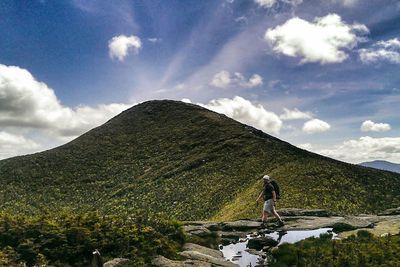
Algonquin Peak is the second-highest summit in New York, part of the MacIntyre Range deep within the High Peaks Wilderness. Its open summit hosts acres of alpine tundra, the largest such zone in the Adirondacks, carpeted with arctic plants including diapensia, Lapland rose-bay, and bearberry willow whose fragile root systems hikers are asked to protect by staying on marked paths.
The standard approach begins at the Adirondack Loj trailhead near Heart Lake outside Lake Placid. The Algonquin Trail diverges from the Van Hoevenberg Trail about a mile in and climbs steeply through boreal forest before breaking above treeline, covering roughly 8 miles round-trip with nearly 2,900 feet of gain. From the rocky summit, 360-degree views take in Mount Marcy, Lake Colden, Avalanche Lake, and on clear days Vermont's Green Mountains. Ambitious hikers can add Wright Peak via a short 0.8-mile side trail or continue over the col to Iroquois Peak, stretching the outing to about 10 miles total.
The MacIntyre Range is composed largely of anorthosite, a rare igneous rock formed under extreme pressure deep within the earth's crust, giving the summits their distinctive gray cast. Conditions above treeline change rapidly; snow typically lingers through May, ice is possible into June, and afternoon thunderstorms are common in summer. A steeper and less-traveled alternate approach climbs from Lake Colden to the southeast, gaining 2,350 feet in just 2.1 miles.
Reference


Weather


Conditions

Trails
 Algonquin Peak and Wright Peak via Algonquin Trail
- Algonquin, Iroquois and Wright Peaks via Algonquin Trail
- Algonquin and Iroquois via Algonquin Trail
- Wright Peak, Algonquin Peak, Iroquois Peak and Avalanche Lake Loop
- Wright, Algonquin, Iroquois, Gray, Skylight, Marcy Loop
- Wright, Algonquin, Colden Loop
- Algonquin Trail to Algonquin Peak
- Wright, Algonquin, Iroquois, Mount Colden, and Mount Marcy Trail Loop